Ideas in Form Assignment :
Explore the relationship between research and making.
- Research a topic of personal interest.
- Create a series of projects informed by your research.
- Document your process on your class website.
Part 1 - Research Part 2 - 2D Project > Part 3 - 3D Project >Part 4 - Interaction Project >
1) Choose Research Topic
For this "Idea in Form" project, the idea from "Vanilla - women emtion tracker", day 3 of 7 in 7 project, was selected to proceed.
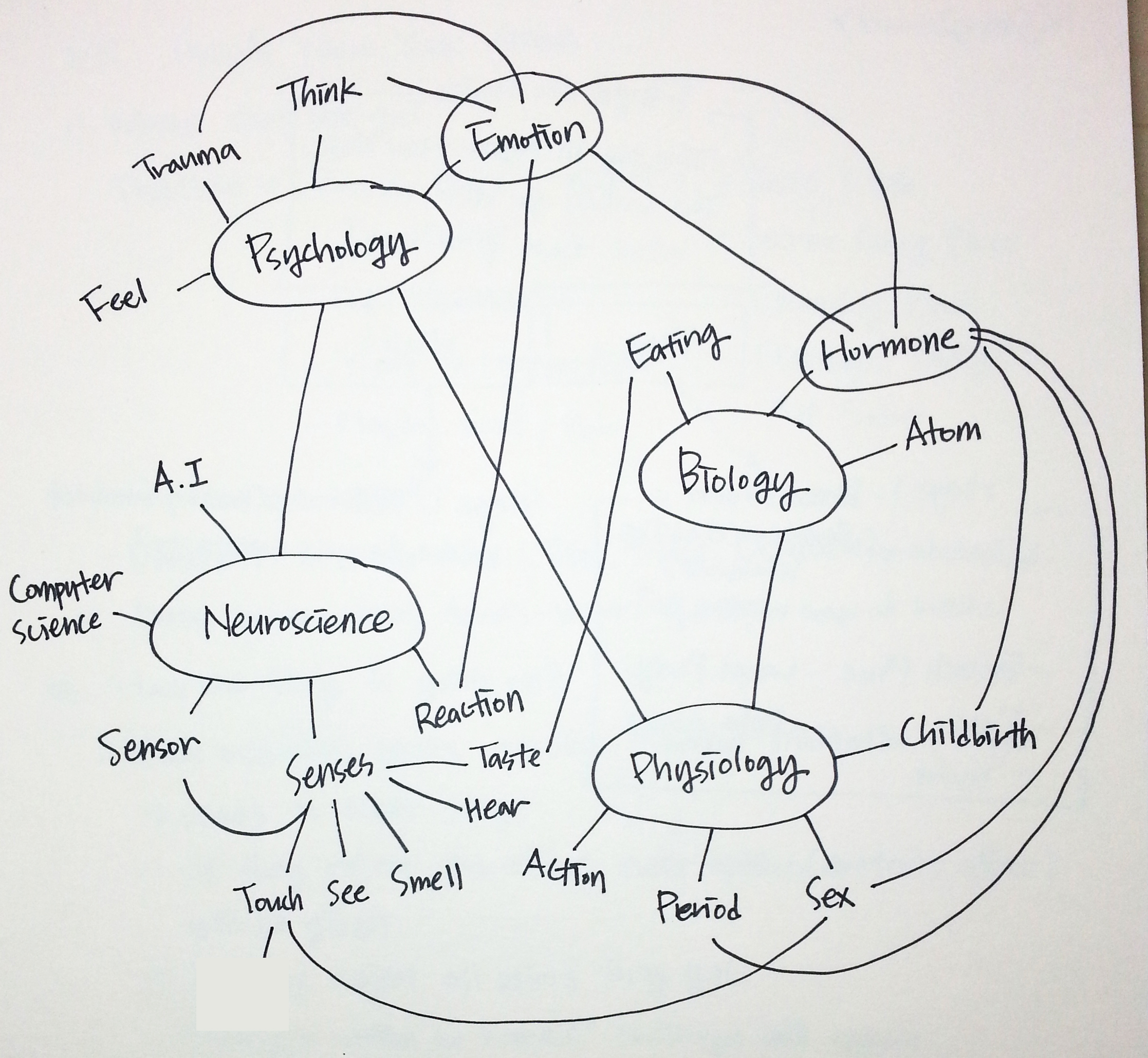
Domain mapping is started with 4 domains - biology, psychology, physiology, and neuroscience.
Domain Mapping and Reframing
Broad and Focused Topics
- Super Broad : Study for all kinds of hormone
- Broad : Hormone related to childbirth
- Moderate : Relation between hormone and emotion
- Specific : How hormone affects emotion in order to maintain women's reproduction
- Super Specific: Difference between hormone which is generating in menstrual, ovulating, and pregnancy period
Research Statement
I am studying the relation between hormone and emotion because I want to find out why every women are suffering from that matter in order to support making reasonable hormone-crisis management system.
2) Broad Research
Domains
Female hormone | Male hormone | Hormone related to reproduction | Hormone and emotion | Menstrual cycle
Overview of the Sources
Due to this broad research, I firstly learned to how women body and hormone are changed by menstrual period, as well as details about organs related to reproduction process. Also I got knowledge about the kinds and roles of each hormone(estrogen, progesteron, androgen, testosterone, FSH, LH, etc), and syptoms when hormone imbalance occurs. According to these different roles of hormones, the emotion status of most women shows drastic changes, for example, PMS. However, most of doctors and researchers tell that the exact treatment that is applicable universally has not been proved yet. Because psycological, neurological, and endocrine systems of human body are interdependent and also depend on individual's current state and situation. The other interesting fact that I found in NY times was the classification of female and male hormone has become to be vague, because both hormones are valuable and essential to keep body and mind healthy regardless of biological gender.
Web Resources Link
3) Secondary Research
Summary
- Bound, Alberti, Fay. Matters of the Heart : History, Medicine, and Emotion, OUP Oxford, 2014.
This book presents in-depth research about mind-body relationship in terms of the matters of heart. The whold book's view is focused on cardiology, but the author also indicates the other possible sources that cause mental and physical diseases. Since twentieth century, for more understanding of emotion and body relations, there were shifts from cardio-centric view to neuro-centric view. Endocrinological, which means related to hormones, explanation had been emerged. For the first time, hormone had become its name which is derived from the Greek, "chemical messenger." The author quotes Osler's The Principles, which represents a slightly annoying view that hysteria is common in women with the reason from not only hereditary and environmental element but also from reproductive organs.
- Gazzaniga, Michael S.. The Cognitive Neurosciences, MIT Press, 2004.
- Odent, Michel. The Scientification of Love, Free Association Books, 1999.
- Crawford, Mary. Transformations : Women, Gender, and Psychology, McGraw-Hill, 2006.
The author mentioned McEwen's experiment which reveals that male and female brains differ in their responses to stressors. Stress and sex hormones, in conjunction with excitatory transmitters, regulate three types of structural plasticity in the adult hippocampus: synaptogenesis, dendritic reorganization, and neurogenesis in the dentate gyrus. For example, estrogens regulate synapse formation in adult hippocampus of ovariectomized females, but not in castrated males. The author supposes that some of this sex differences were programmed, whereas others reflect the interaction between gonadal hormones and ongoing stress.
The author emphasizes a specific sex hormone other than estrogen, progesteron, or testosterone, it is oxytocin. Oxytocin is expressed as "altruistic" hormone, and it plays a impressive role during intercourse, childbirth, and lactation. In particular, its level in the blood of men and women during masterbation and orgasm was continous, especially women had a higher level than men. Indeed its level is higher during the second phase of the menstrual cycle than the first phase. Also endorphins genereated with oxytocin, represent "reward system" because they are hormones of pleasure and natural pain killer.
Generally this book covers the sociological view of women, however, I found interesting point to apply my project. It is about the various researched on women's sexual experiences. The first sexual experience of most of American women (including all Asian women absolutely!) were not so pleasant to them, and orgasms are too hard to reach. The author introduced the positive aspects of self-gratification for the future relationship. For example, in a study of married women aged 18 to 30, those who had experienced orgasm through self-gratification had more orgasms with their partners, greater sex desire, more rapid arousal, higher self-esteem, and greater marital satisfaction than those who had not (Hurlbert & Whittaker, 1991).
4) Primary Research : Survey
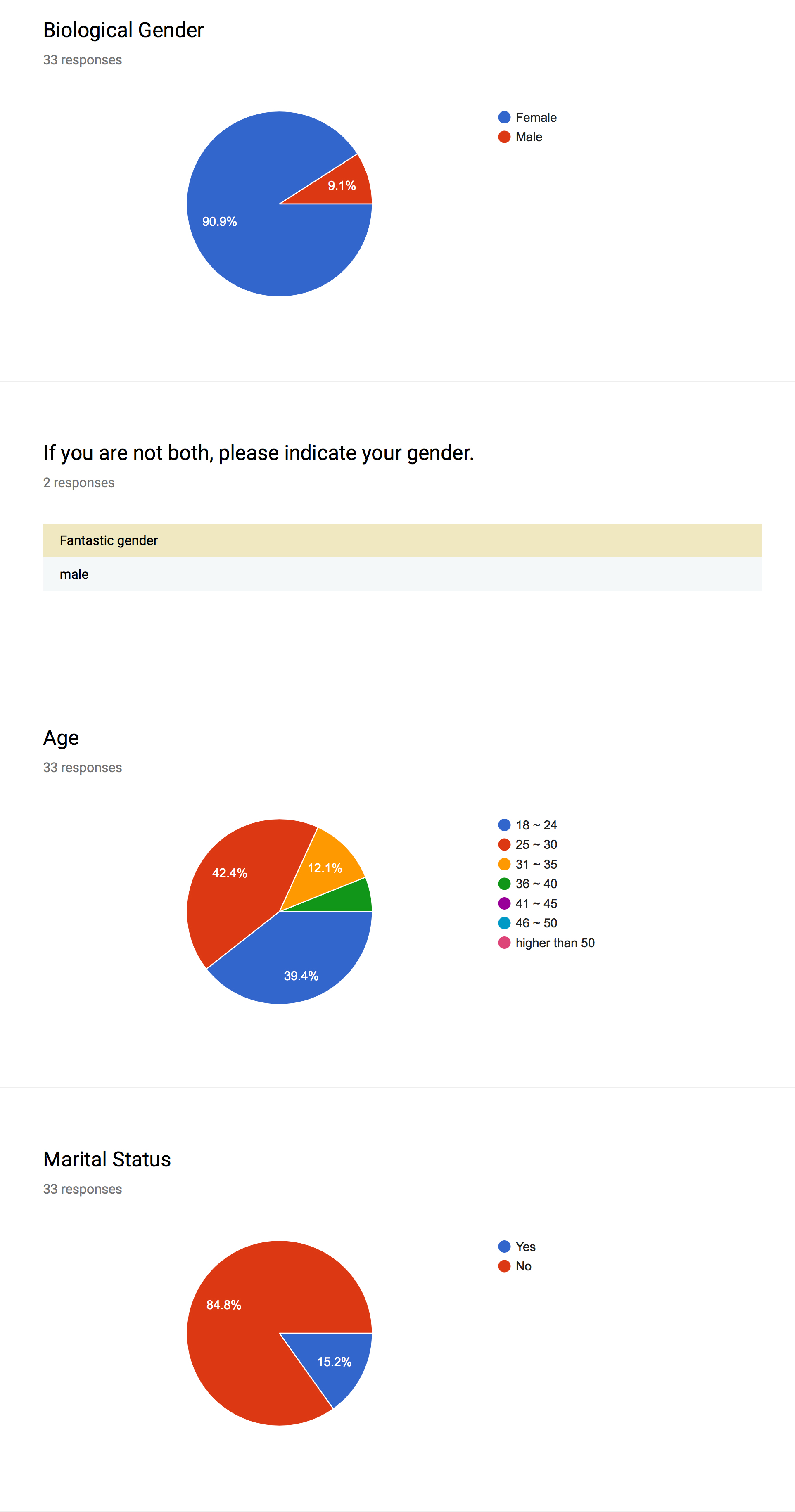
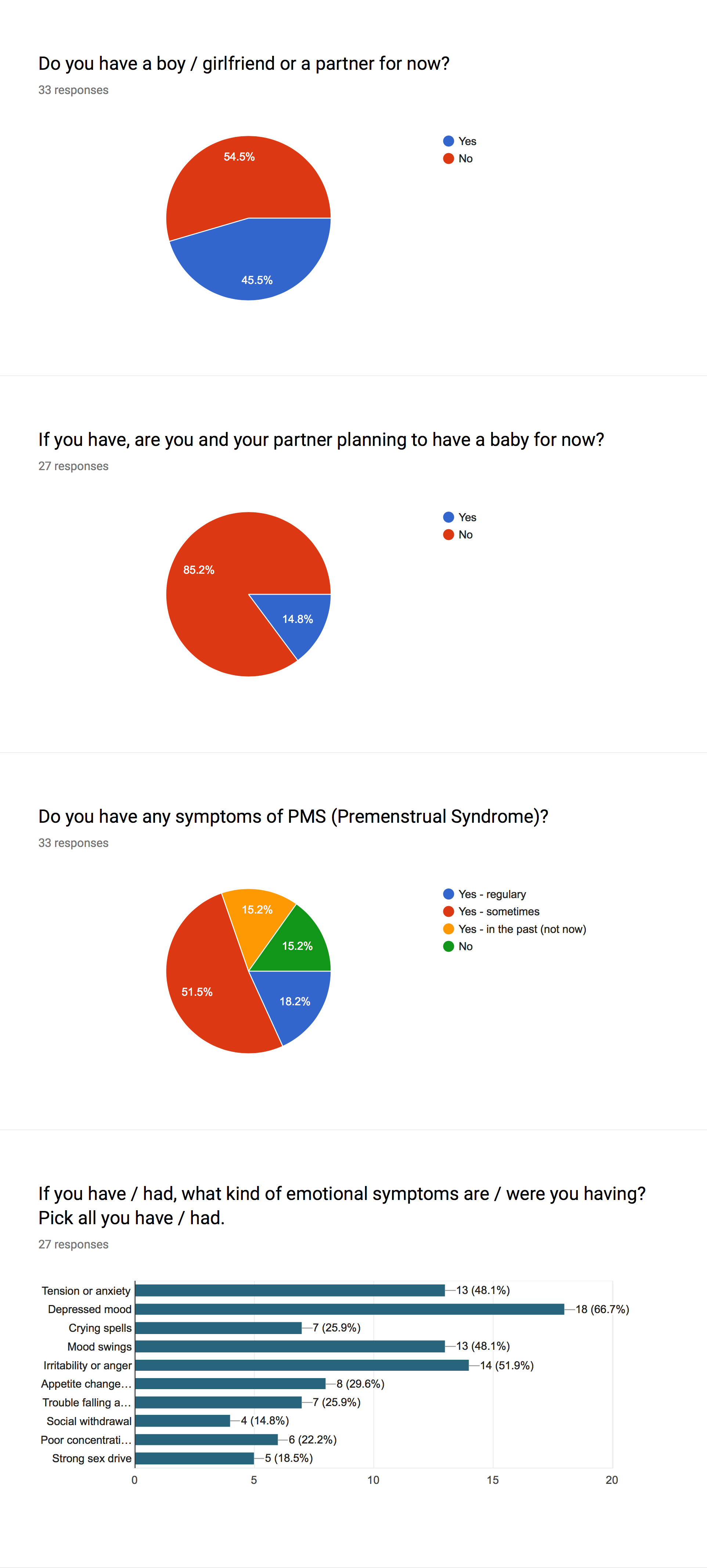
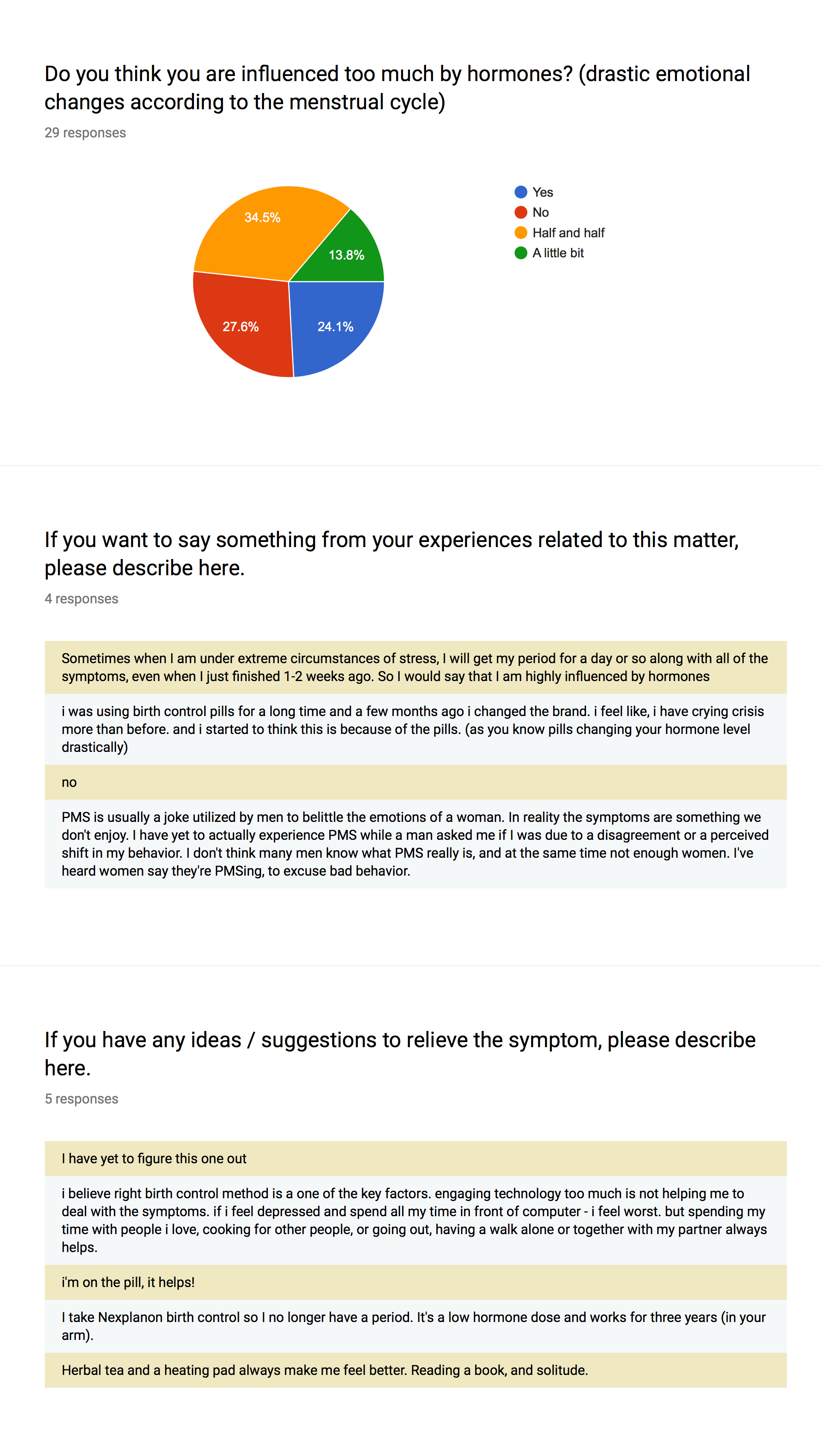
As a primary research, survey was performed. There were 33 women respondents aged 18 ~ 40.
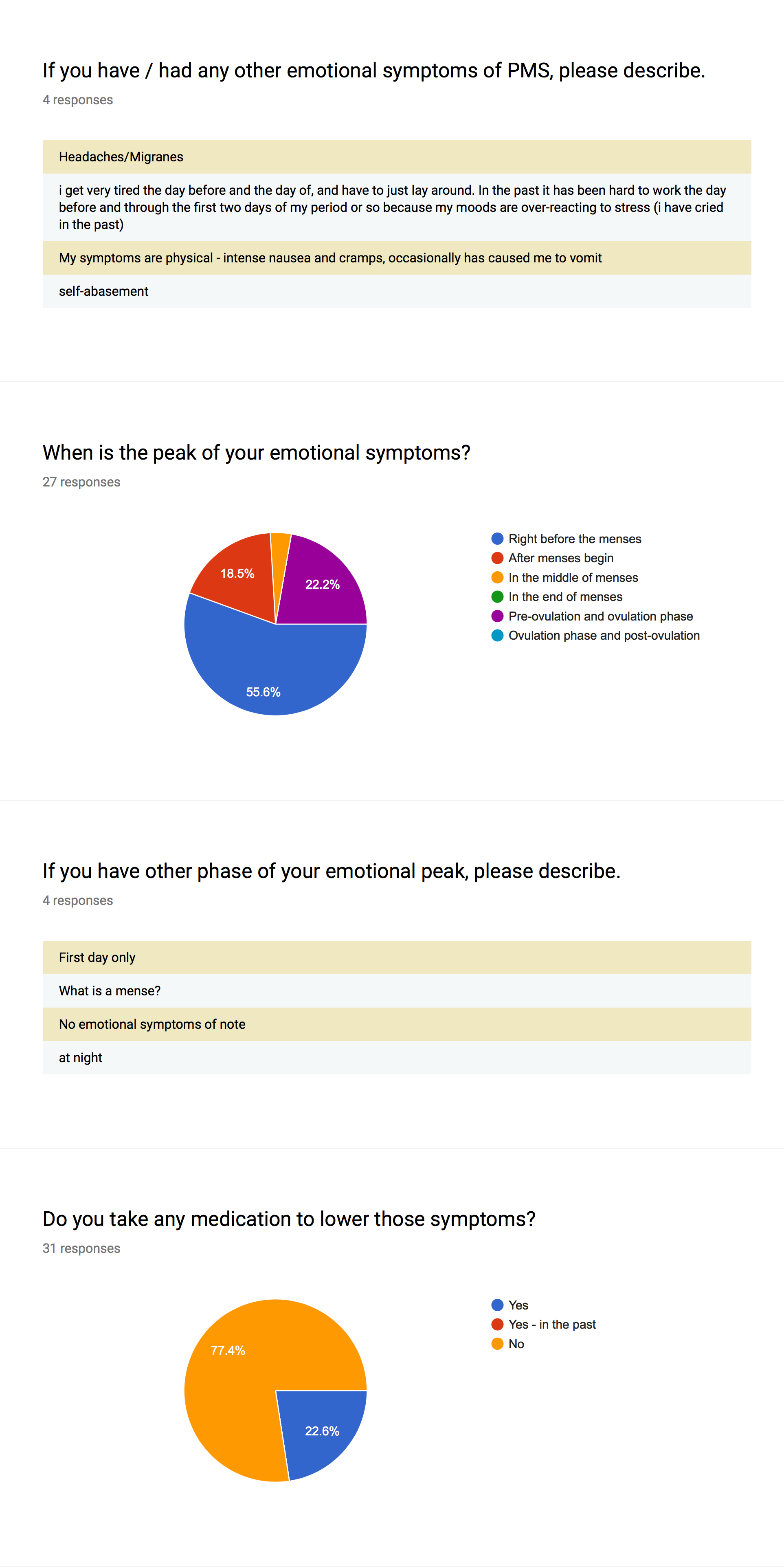
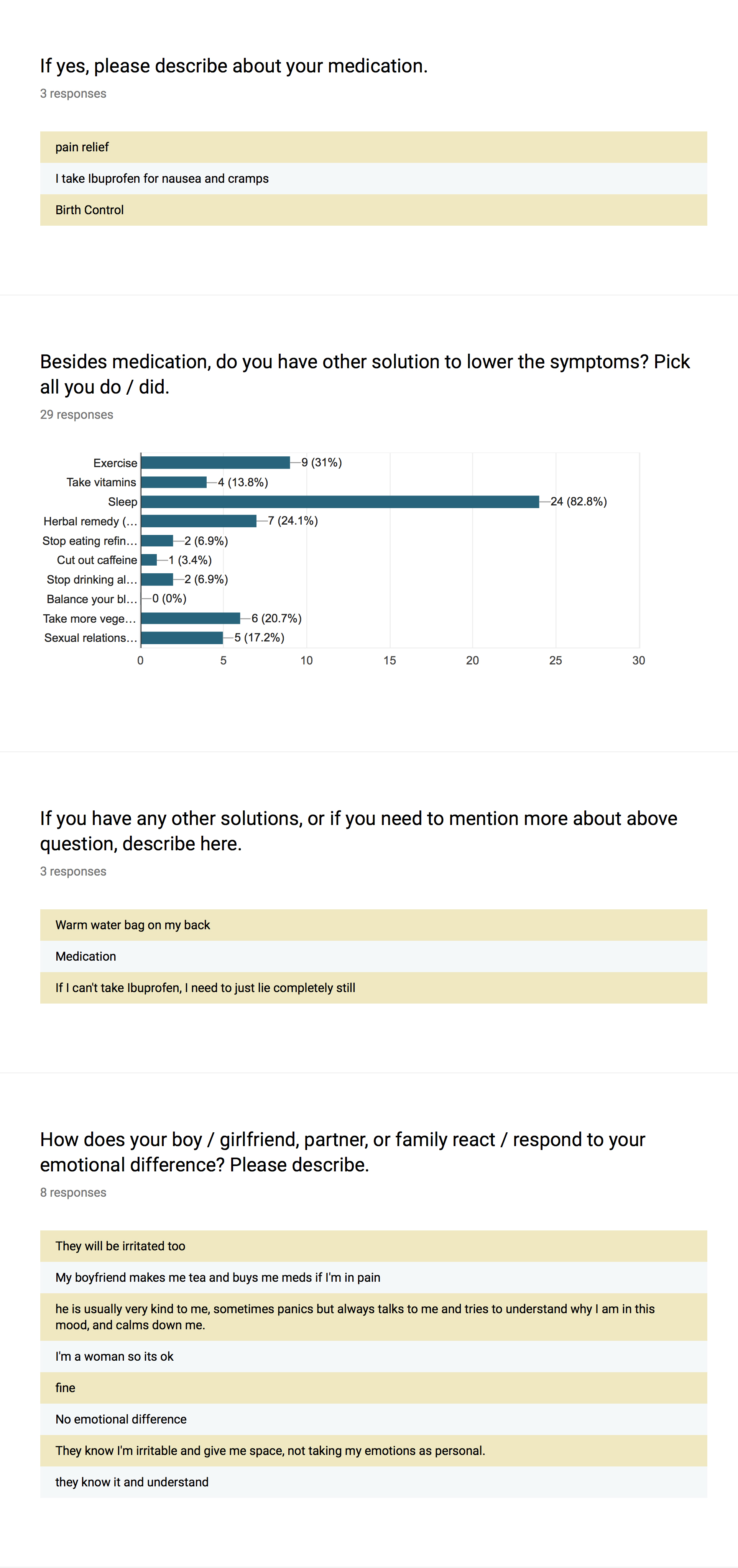
Questions were constituted with the kinds and types of emotional symptoms of PMS, including the peak and their own solutions for that.
Questions and Answers